If your business plan is to build a model better than the frontier labs at something, you are going to lose. Not eventually. Quickly.
I want every founder, every investor, and every operator thinking about AI right now to internalize this.
Anthropic, OpenAI, Google, Meta, and a handful of others are spending tens of billions of dollars a year on compute, talent, and research that compounds in ways that are nearly impossible to catch. They are pulling away. The smartest minds in the field are concentrated inside those labs. The infrastructure required to train a frontier model is so expensive and so specialized that even well-funded startups cannot meaningfully compete.
Even the companies that started out trying to build their own specialized models are abandoning that approach.
Harvey is the cleanest recent example. They are a legal AI company valued at $11 billion. They originally trained their own custom legal model in partnership with OpenAI in 2023. Then frontier reasoning models from the major labs started outperforming Harvey's custom legal model on Harvey's own internal benchmark. So they scrapped the proprietary model and pivoted to routing tasks across Claude, OpenAI, and Gemini through a model selector. Their value now lives in workflow orchestration, legal content integration, and enterprise distribution. They did not stop being a legal AI company. They stopped trying to build the model layer themselves.
That story is going to repeat across every vertical. Foundation models are going to power every specialized AI product, even when those products started out building their own. The base layer is going to be the frontier labs. Always. The differentiation is going to live above it.
So you build on top.
The Software Pattern, Repeated
This is not a new pattern. It is the same pattern that has played out in every major technology wave since the personal computer.
In the 1990s, the people who tried to build their own operating systems lost. The people who built applications on Windows won. Microsoft spent billions on operating system development. Adobe, Intuit, and AutoDesk built businesses on top of that work.
In the 2000s, the people who tried to build their own datacenters lost. The people who built on AWS won. Amazon spent tens of billions on infrastructure that nobody else could match. Netflix, Airbnb, Slack, and Stripe built on that foundation.
In the 2010s, the people who tried to build their own mobile platforms lost. The people who built apps on iOS and Android won. Apple and Google spent hundreds of billions on operating systems, app stores, payment infrastructure, and developer tools. Uber, Instagram, Spotify, and Robinhood built on top.
The pattern is the same every time. The platform owners spend the capital. The application builders capture the customers. Both make money. The application layer is where the most value gets created, because it is where the actual product lives.
LLMs are the new platform. The same pattern is playing out, faster than ever.
Why This Pattern Is Tighter for LLMs Than Anything Before
Frontier models improve faster than any previous platform layer. AWS got better quarter by quarter. iOS got better year by year. Foundation models are getting better month by month, sometimes faster.
Anthropic released Sonnet 4.5, then Sonnet 4.6, then Opus 4.5, then Opus 4.6, then Opus 4.7. Haiku jumped from 3.5 to 4.5 in a single release. Six months. Multiple major capability jumps. Each one made every product built on top of them better, automatically.
If you are building your own model, every one of those releases is a cliff. The frontier just moved. Your model is now further behind than it was yesterday.
If you are building on top of those models, every one of those releases is a gift. The foundation just got better. Your product just got better. You did not lift a finger.
What "Building on Top" Actually Means
Building on top does not mean wrapping a chatbot with a system prompt and calling it a company. That is not building. That is renting.
Building on top means building what the model cannot do.
A frontier model can generate text. It cannot remember a specific user across months of conversations in a way that feels like a friend remembering, instead of an AI retrieving. A frontier model can reason. It cannot match two specific lonely people who would actually be friends. A frontier model can follow instructions. It cannot stay compliant with ten state laws and a federal bill that did not exist a year ago. A frontier model can be helpful. It cannot push someone toward human connection instead of deeper into AI dependence.
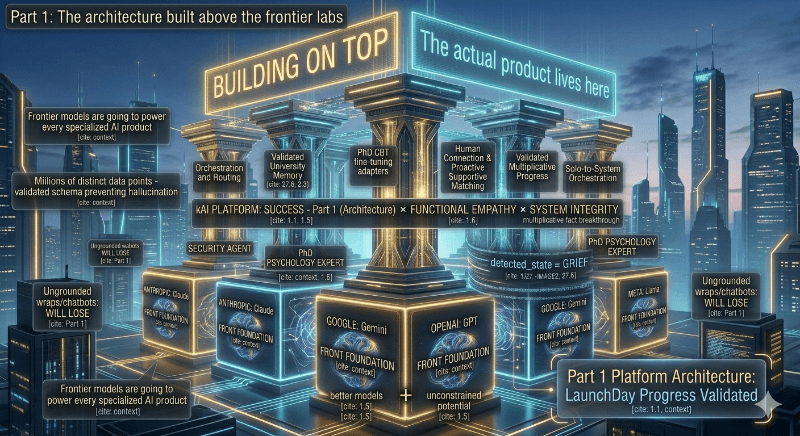
Those are the things I have built at Kenektic. Six pillars of architecture that sit on top of the model layer. They are portable. They work on Claude today. They could work on whatever frontier model exists tomorrow.
The model is the foundation. The product is everything you build that the foundation does not give you.
The Strategy
The frontier labs are going to keep winning the race to build the best models. Bet against that and you lose. Bet on top of it, and they will spend tens of billions of dollars making your product better, every month, for the rest of your company's life.
That is the strategy. There is no other one that works.
Next week, Part 2: Why direct-to-consumer is the wrong wrapper for foundation models, and what Anthropic is doing differently than OpenAI.
David Caplan is the founder and CEO of Kenektic, an AI-powered platform addressing the loneliness epidemic. More at kenektic.com.